



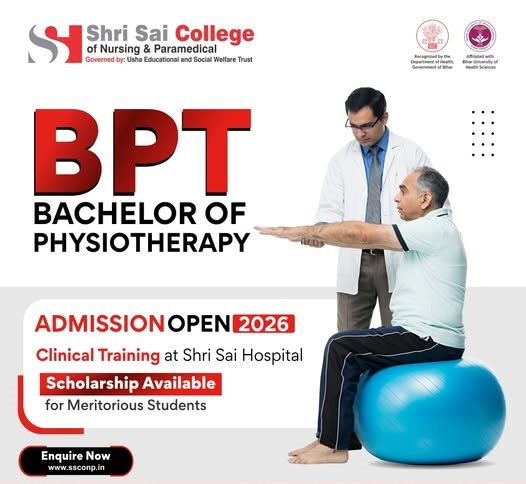
Bachelor of Physiotherapy (BPT) is a professional healthcare course focused on the prevention, diagnosis, and rehabilitation of physical movement disorders and injuries. The course provides students with practical knowledge and clinical training in physiotherapy techniques, exercise therapy, and patient care. BPT prepares students for careers in hospitals, rehabilitation centres, clinics, sports facilities, and other healthcare settings, helping patients improve mobility, strength, and quality of life.
Program Highlights

Physiotherapy
Program
Duration
4 Years & 6 Months Internship
Credits
60
Eligibility
10+2 with PCB
Objectives of Bachelor of Physiotherapy (BPT) Course
- To develop skilled and knowledgeable physiotherapy professionals.
- To provide students with strong theoretical knowledge and practical clinical training.
- To teach effective techniques for improving mobility, strength, flexibility, and physical function.
- To train students in the assessment, treatment, and rehabilitation of patients with physical disabilities and injuries.
- To develop professional skills, communication, compassion, and ethical values for quality patient care.
- To prepare students for careers in hospitals, clinics, rehabilitation centres, sports facilities, and other healthcare settings.
Career options after BPT (Bachelor of Physiotherapy) course ?
After completing a BPT course, graduates can pursue careers in various healthcare and rehabilitation settings, including:
- Physiotherapist – Work with patients to improve mobility, strength, and physical function.
- Hospital Physiotherapist – Provide physiotherapy and rehabilitation services in hospitals.
- Clinical Physiotherapist – Work in private physiotherapy clinics and healthcare centres.
- Rehabilitation Specialist – Help patients recover from injuries, surgeries, disabilities, and physical conditions.
- Sports Physiotherapist – Work with athletes and sports teams to prevent and manage injuries.
- Paediatric Physiotherapist – Provide physiotherapy care to children with developmental and physical conditions.
- Home-Care Physiotherapist – Provide physiotherapy services to patients in their homes.
- Academician – Pursue teaching and academic opportunities after gaining the required higher qualifications.
- Private Practice – Start and manage a physiotherapy clinic after meeting applicable professional and regulatory requirements.
Eligibility
- Course Duration: BPT is a 4½-year program, comprising 4 years of core theoretical subjects, laboratory work, and clinical training, followed by a mandatory 6-month internship providing hands-on training in hospital and healthcare institutions.
- Students who have completed their 10+2 with Bio from a recognized board are eligible to apply for the BPT course, subject to the latest admission guidelines and eligibility criteria.
Fee Structure
FEES
₹350000
The total fee for the B.Sc. Nursing (INC Approved) program at Shri Sai College of Nursing & Paramedical, Patna is ₹9.5 Lakhs. To make quality nursing education accessible to deserving students, the college facilitates the Bihar Student Credit Card Scheme (BSCC), under which eligible students can avail educational loans to support their academic journey. Our fee structure has been thoughtfully designed to comply with all regulatory norms while ensuring affordability and financial flexibility for students from diverse socio-economic backgrounds. For students and parents evaluating private nursing college fees in Bihar, Shri Sai College offers an excellent balance of quality education, modern infrastructure, experienced faculty, clinical exposure, and long-term career value. With access to financial assistance through government-supported schemes, aspiring nurses can pursue their professional goals without undue financial burden.
To support students in achieving their educational goals, the Bihar Student Credit Card Scheme is available.
- Up to ₹4 Lakh through DRCC (District Registration and Counseling Centre)
Curriculum Overview
Our university curriculum is designed to deliver a balanced future-focused learning experience that empowers students with both academic knowledge and practical competencies Each program is structured to combine foundational coursework specialized major subjects hands-on learning and interdisciplinary opportunities By integrating theory research and real-world applications we prepare students to excel in a rapidly evolving global environment Students begin with core courses that build essential skills in communication, critical thinking, digital literacy, and quantitative analysis.
Curriculum Breakdown Summary
Our curriculum is structured to provide a well-rounded, progressive learning journey that supports both academic excellence and practical skill development. It is organized into four key components: Core Courses, Major Requirements, Electives, and Experiential Learning.
| Regular Students | Required Credits |
|---|---|
| Core Courses | 30 Credits |
| Science (S) Core | 30 Credits |
| Business (B) Core | 3 Credits |
| GPA | 3 Credits |
| Total | 90 Credits |
Core Courses
The Science (S) Core develops a strong foundation in scientific principles, analytical thinking, and evidence-based problem-solving These courses introduce students to the fundamental concepts of the natural world while strengthening their abilities to observe, experiment.
| Semester 1 | Courses Code | Core Courses | Credits |
|---|---|---|---|
| Foundations in Communication & Critical Thinking (12 Required Credits) | IBS301 | International Business Management | 3 Credits |
| BUS109 | Introduction to Microeconomics | 3 Credits | |
| MKT200B | Principles of Marketing | 3 Credits | |
| BUS308B | Strategic Management | 3 Credits | |
| Accounting | BUS325B | Introduction to Operations Management & Decision Science | 3 Credits |
| FIN305 | Introduction to Corporate Finance | 3 Credits | |
| BUS110 | Introduction to Macroeconomics | 3 Credits | |
| ACC101 | Introduction to Accounting | 3 Credits | |
| Management | BUS100A | Introduction to Business | 3 Credits |
| BUS211C | People and Organization | 3 Credits |
Science (S) Core
The Science (S) Core develops a strong foundation in scientific principles, analytical thinking, and evidence-based problem-solving These courses introduce students to the fundamental concepts of the natural world while strengthening their abilities to observe, experiment.
| Semester 2 | Courses Code | Science | Credits |
|---|---|---|---|
| Science | PHY 101 | Conceptual Physics | 3 Credits |
| BIO 105 | Introduction to Life Sciences | 3 Credits | |
| S-109 | Introduction to Physical Science | 3 Credits | |
| ENV 110 | Environmental Science | 3 Credits | |
| Technology | CS 101 | Digital Foundations and Applied Programming | 3 Credits |
| TECH 205 | Management Information Systems (MIS) | 3 Credits | |
| ENGR 100 | Introduction to Engineering Principles | 3 Credits | |
| DATA 210 | Data Management and Visualization | 3 Credits | |
| Mathematics | MATH 115 | College Algebra and Trigonometry | 3 Credits |
| STAT 201 | Probability and Statistics | 3 Credits |
Business (B) Core
The Science (S) Core develops a strong foundation in scientific principles, analytical thinking, and evidence-based problem-solving These courses introduce students to the fundamental concepts of the natural world while strengthening their abilities to observe, experiment.
| Semester 3 | Courses Code | Business Core | Credits |
|---|---|---|---|
| Finance | IBS301 | International Business Management | 3 Credits |
| BUS109 | Introduction to Microeconomics | 3 Credits | |
| MKT200B | Principles of Marketing | 3 Credits | |
| BUS308B | Strategic Management | 3 Credits | |
| Accounting | BUS325B | Introduction to Operations Management & Decision Science | 3 Credits |
| FIN305 | Introduction to Corporate Finance | 3 Credits | |
| BUS110 | Introduction to Macroeconomics | 3 Credits | |
| ACC101 | Introduction to Accounting | 3 Credits | |
| Management | BUS100A | Introduction to Business | 3 Credits |
| BUS211C | People and Organization | 3 Credits |



| Spring 2025 | Summer 2025 | Fall 2025 | Winter 2025 | Annual | |
|---|---|---|---|---|---|
| 17 weeks | 6 weeks Summer 1, 3 Weeks Summer 2, 3 Weeks | 16 weeks | 17 weeks Winter 1, 3 Weeks Winter 2, 3 Weeks | Costs USD | |
| Enrollment Fee (Onetime fee) | $560 | $560* | $660 | ||
| Orientations Fee (Onetime fee) | $159 | $159* | $159 | ||
| Medical Insurance (Yearly) | $68 | $68 | |||
| Tuition | $4,129 | $1,139 | $5,138 | $1,028 | $11,434 |
| Residence | $728 | $364 | $728 | $364 | $2,184 |
| Breakfast Fee | $448 | Not offered | $448 | Not offered | $896 |
| Activity Fee | $100 | $100 | $200 | ||
| Total First Year | $6,192 | $1,503 | $7,133 | $1,392 | $16,220 |
| Total Second Year | $5,192 | $1,503 | $7,133 | $1,392 | $15,220 |
Apply Now
Our program costs are designed to remain transparent competitive and accessible for students from diverse backgrounds. Each academic program includes tuition fees, registration charges and essential learning resources ensuring students receive high-quality education and comprehensive academic support Costs may vary based on program type, course load, and mode of study (on-campus, hybrid, or online) We aim to provide exceptional value through modern facilities, expert faculty, and industry aligned curriculum making your investment in education both meaningful and future-focused.
Undergraduate
Begin your academic journey with flexible entry requirements and application.


International Students
Join a diverse campus community through a simple application and visa guidance.
Requirements and Deadlines
Our program costs are designed to remain transparent competitive and accessible for students from diverse backgrounds. Each academic program includes tuition fees, registration charges and essential learning resources ensuring students receive high-quality education and comprehensive academic support Costs may vary based on program type, course load, and mode of study (on-campus, hybrid, or online) We aim to provide exceptional value through modern facilities, expert faculty, and industry aligned curriculum making your investment in education both meaningful and future-focused.
Admissions Requirements
1. Academic Qualifications
2. Required Documents
3. English Language Proficiency
4. Entrance Exam / Interview
5. Additional Requirements (Program-Specific)
6. Financial Requirements



Apply Deadlines
| Program Level | Admissions Session | Applications Open | Application Deadline | Classes Begin |
|---|---|---|---|---|
| Undergraduate | Spring Intake | October 1 | December 15 | January 10 |
| Undergraduate | Fall Intake | April 1 | July 30 | September 1 |
| Postgraduate | Spring Intake | October 1 | December 30 | January 15 |
| Postgraduate | Fall Intake | April 1 | August 10 | September 5 |
| International Students | All Intake | 6 Months Before | 2 Months Before | As Scheduled |
Requirements and Deadlines
Our program costs are designed to remain transparent competitive and accessible for students from diverse backgrounds. Each academic program includes tuition fees, registration charges and essential learning resources ensuring students receive high-quality education and comprehensive academic.